Monday, May 13, 2013

Do RPGs Have To Be Played Before Reviewing?

This came up in reference to my review of The Future Belongs to Us. The author emailed me and wasn't happy I had reviewed the game without playing it.

But do you have to play an rpg to review it? Is it unreasonable to evaluate one on reading alone?

From this perspective, the entire game must be reviewed, from soup to nuts. If you don't it's like forming an  opinion of a movie or piece of music without experiencing it. Anything else is invalid and not a complete picture. Nobody would take a review of a movie seriously if the reviewer hadn't viewed the whole thing.

But rpgs are books. They can be evaluated on content, layout, art, writing and the rules. Anyone with a technical eye toward game mechanics can get a good idea of how the game will play just with a read through. I don't need to play a game to know a single d20 has a flat distribution of results, or that 1s being fumbles and 20s being critical results in a 10% chance of an extreme result and how that will affect play. I've been there and done that. When I read Exalted 2nd edition I knew the ticks, AV, and DV would be problematic for me. Turns out when I tried to run it, I was right.


That's not to say playtest reviews aren't desirable. They are - but the subjective nature of actual play, makes it no more valid than a "capsule review". The two things exist for a reason. Reviews are opinions based on experience and  subject knowledge. Anybody who has played more than a handful of systems (and I've played more than a handful) can see how all of the pieces fit together, just as they can make any game "work" and likely have fun while playing it.

But there's a final piece here that's particularly relevant to The Future Belongs To Us review: I couldn't have playtested it fully because it's a player's guide. The book has swathes of information that is vague or simply not there which is most likely in the gamemaster's guide. A playtest wouldn't have done it justice, and had I done that the review would have been much worse. Plus, there were hover gorillas and Lando Calrissian fighting ninjas over a treasure chest and I don't think I could live up to that challenge.


Saturday, May 11, 2013

The Future Belongs To Us Review

Full disclosure: the author approached me to do a review and I agreed, on the condition that I would make the review fair but there was no guarantee it would be favorable. I’ll try, but as Nick Lowe said, “Sometimes you have to be cruel to be kind.” EDIT: the author has requested I clarify that this is not a playtest review. More on this subject tomorrow.

A couple days ago I received a package containing The Future Belongs To Us Player’s Guide (hereafter TFBTU) from Ataraxy Publishing. It is 192 pages long, soft-bound book with a full color cover that could do with less deformed-breasted porn-star. The back cover blurb says:
“After the Dragons...
 After the Wolf...
 The next generation of role-playing excitement”
And claims:
“The DiceLight system brings many new innovations to the RPG hobby”
That is...not encouraging, because those pronouncements in back cover blurbs are almost a guarantee that none of those things are happening inside the book.

Layout and Art

The book’s layout is very simple and no frills, without any decorative borders or other embellishments. The text is large and easy to read - it may be a tad too large. The book is divided into sections covering the setting, rules, character creation, skills, etc. The organization is a little scattered, causing some page flipping. It does get points for having clear writing with very few spelling or grammatical errors.

But the art...you just have to see it because I can’t describe it. It’s not bad, it’s “LOL WTF”. Every piece lacks perspective and proportion, and many are weird or have nonsensical subjects. When I showed one of the pieces to a coworker he just stared at it for a few seconds - his mind couldn’t comprehend what he was seeing. What’s worse is the art doesn’t seem to match up to anything in the setting.

If I ever play this game, I am demanding a hover gorilla


I'm still trying to parse this one...

Setting

The setting is basically this: the UN has taken over all of the things, there’s one world currency, firearms are illegal everywhere so only criminals have guns, violent crime is on the rise, there isn’t any privacy, and a single gang called the Hardbodies has somehow taken over all organized crime. Somehow the Hardbodies managed to massacre 10,000 police officers in New York. Business charge entry fees and run background checks before customers can enter. Just like  the art, if this were tongue in cheek like Underground or something along the lines of John Shirley’s Eclipse Trilogy I could suspend disbelief. This makes me feel like I’m reading my Facebook friends feed (how did so many of my friends become survivalist-types, anyway?), or a Left Behind book crossed with one of those alarmist speculative fiction books written by a survivalist to scare people into buying ammo and gold.

The System

The attributes in TFBTU are a typical spread: Dexterity, Agility, Strength, Perception, Build, Ego, Stamina. Ego and Stamina are “Determining Attributes” that set the value for two derived...I mean “Dynamic”...attributes: Passion and Energy. Aside from attributes you have Knowledges, Skills and Proficiencies. The delineation is a little hazy, but Knowledges do not have ratings and are things the character has, well, a knowledge of. Skills are areas of expertise and Proficiencies are kind of narrow areas of Attribute focus. There is also a martial arts system, technically making four areas for players to purchase abilities.

The die mechanic is roll d20 + attribute + bonuses from proficiencies or other modifiers versus a target number. Skills have different automatic effects per level, such as being able to write a specific complexity of software. As such, skills are not rolled for. There's very little in the book on adjudicating how skills and proficiencies tie together when rolling.

Passion seems to be part of the game’s claim of innovation. Every day the Passion attribute resets itself, and points can be spent from it to increase rolls, reroll extraordinary failures, or revive from being knocked unconscious. When things happen, like something good or bad happens to the character, Passion can be increased or decreased. Along with Extropic Points this gives two pools that can be used to get bonuses or effects on die rolls.

One issue with the skill/knowledge/proficiency arrangement can be seen in how firearms are handled. There is a Firearms Knowledge that means the character knows which end to point at the target and not shoot their own face off. Then there is a Weaponry skill that means the character has...knowledge of weapons. Finally there is a Ranged Weapon proficiency that provides a bonus to attacks. Whether all of it makes sense is arguable, so I’ll leave it alone because system-wise there’s bigger fish to fry.

There are also some odd choices in terms of how things are categorized. Telecommunications inexplicably encompasses hacking and bypassing computer/network security. The proficiency to get a bonus for piloting a rotary wing aircraft, submarine or spacecraft is called Free Motion Vehicles. There is a skilled called Rearrangement for switching weapons and proficiencies for Leg Strength and Upper Body Strength. I’ve never once asked myself why these things aren’t present in other games...and probably for good reason.

But the bigger fish I mentioned is attributes, skills, and proficiencies all have different ranges. Not just between types, but between one another. The attributes are on one of five different ranges ranging from 1-3 to 2-30 (in case you’re keeping score at home, that means only two attributes have the same range). Likewise, the ranges for the skills and proficiencies can range from just a couple to ten or more. Each has customized benefits or modifiers for each level, meaning each one is its own little self-contained rules packet. It makes it very fiddly and more complicated than it needs to be.


The points that are used to buy all of this stuff are called Extropic Points, and a starting character not using a template has 4000 of them. Just like each attribute, knowledge or skill has its own rating ranges, each one has its own costs per level. Stamina is 3 per level, but Perception is 5, Strength is 30 and Dexterity is 160. Climbing is 3 per level, while Surface Vehicles are 23, Running is 11 and Leg Strength is 23. Meanwhile, skills are 1 per level and knowledges just cost 1 each. Starting wealth can be purchased with Extropic points as well, plus various character enhancements. Extropic Points are also given out as experience points and can be spent on character improvement, as well as various character enhancements. What those enhancements are is mentioned but not details, because they are actually going to be in a separate book (the equipment section is 27 pages of gun porn, followed by some vehicles, some robots and some miscellaneous equipment).

There are a number of character templates provided so the player doesn’t have to try to distribute 4000 points in increments from 1 to a 1000. How the templates work with one another would require a playthrough, so I’ll trust they work well with one another. 

Now, aside from the Extropic Points being oddball amounts, there’s the question of whether or not the relative differences are really equal. Is having a point of Strength really 10 times more useful/expensive/whatever than a point of Stamina? It’s an extension of the same problem I have with systems like GURPs. Is there really any need to measure the skill levels in hundreds of points? It comes off as overcomplicated and (more) arbitrary than a game needs to be.

Conclusion

As a player's guide, the book fulfills its mission - it describes how to create a character and seems to cover all of the bases. Undoubtedly the GM's Guide will cover adjudicating the rules, so aside from the basic mechanics covered in the Player's Guide it's hard to judge how good the system is. It definitely fulfills the "DiceLight" moniker by only using one die and having a single resolution mechanic. The over complicated system of having each attribute, skill, proficiency, etc. essentially have its own rules does a lot to turn me off from the system - I'm not fond of "exception-based systems", such as Exalted's Charms or the proliferation of stunts in Spirit of the Century.

However, TFBTU is a freshman effort and it shows. It’s obvious a lot of work went into the product, the writing, and the rules. But the system isn’t really anything new or innovative, and could probably fall through a wormhole into 1988 and nobody would look twice. It has some of the hallmarks of a heartbreaker: enthusiasm from the author that the game contains stunningly new concepts, a little bit of naivety regarding marketing their games (what first brought the game to my attention was a "press release" on Tabletop Gaming News). The Passion attribute has promise, but there are plenty of other systems out there that offer similar mechanics - and a number (such as Fate) that go even further to give narrative control to the players. Finally, in a perfect world, artwork wouldn’t be important - but no art is better than poor art. The Future Belongs To Us just isn’t quite ready to live up to its own hype.


KIckstarter (Or What Happened To My Self Control)

Apparently I'm exactly the kind of sucker people who Kickstart rpg projects want to have. I typically can't back at a really high level, but I get swept up in the hype and excitement of watching the project break through it's funding goals and skyrocket past them. I like stretch goals, I like backer updates, I like previews and draft versions. It makes me feel involved in the process of getting the games published.

Since January, I've backed Kickstarters at higher levels than my entertainment budget for the entire previous yaer. My entertainment budget is typically for books, video games, movies, rpgs, and music. So far, I've only backed Kickstarters. The Fate Core Kickstarter was already grown up and ready to go to college by the time I got involved, but the Apotheosis Drive X Kickstarter was a blast. I felt like I was actively contributing, no matter how small of a contribution it may have been. The same for the Spark rpg Kickstarter. And there were still more that I would have backed, like Short Order Heroes, and I want to (if I can) back Trigger Happy.

And I just bumped up my pledge for the Deluxe Exalted 3rd Edition Kickstarter. I think I need help.


Friday, May 10, 2013

Flashback Friday: Cybergeneration


I was an enormous Cyberpunk fan in the late 80s and early 90s. I bought the original boxed set when it first came out and by the time the Cyberpunk 2020 line was finished I had every book, including ones published by third parties. The only game I have more memories of playing is Mekton.

So when Cybergeneration came out, it was an automatic buy for me. It wasn't an automatic love affair. Kids? Nanotech powers? Strange names for skills like "Lil Angel"?  Cheesy "yogangs"?. The Cybergeneration types were really awesome, the premise was cool, and I liked the stripped down system. A lot of the artwork was done by Alex Racine, an artist who was one of my favorites out of the R. Talsorian Games stable. I just didn't know what to do with it at first. I ran a couple of games and the system worked well, although the games fizzled out for various reasons. I did wind up buying the supplements because they had a lot of good information in them.

 Cybergeneration uses a simplified Interlock system. The base stats are the same but are capped at 8, as are skills. Like I mentioned, the skills list has been rewritten to better represent youth skills. Multiple "Edgerunner " skills are combined into one, such as Streetfighting covering pretty much all combat skills. Other examples include "Get a Clue" and "Blend". Overall the characters have fewer points than their CP2020 counterparts to represent the character's youth. The dice mechanics are the same as Interlock (1d10 + Stat + Skill), but the combat system is simplified and streamlined. In a clever move, the yogang skills have their level halved when going up against an adult.

It also had Akira hanging out with Ke$ha
The premise of the game is that in 2025, a nanotech virus called The Carbon Plague was unleashed. If it infects an adult, that adult dies. If it infects a kid, most likely nothing will happen but. In a small percentage of children, they are changed into one of the "Evolved". By 2027 the  government has rebooted itself with the backing of the most powerful megacorps and reasserted some semblance of order. For the most part, the streets are a lot safer than 7 years before, but it's at the expense of being completely beholden to the corporate machine.  The Edgerunners of CP2020 have retired, been killed or driven underground - the corporations won, in essence.

The Carbon Plague gives the kids an array of nanotech-driven abilities, divided into five types:
  • Tinmen: They are able to reshape their limbs T-1000 style.
  • Wizards: Basically Netrunners that can use their brains instead of a cyberdeck.
  • Alchemists: They can create objects and destroy them.
  • Scanners: They can manipulate nervous systems, both theirs and others'.
  • Bolters: They can use electrical ranged attacks.
Of course, the Incorporated States of America wants to get its hands on these kids. The book uses a guided introductory scenario to set up the PCs becoming infected, escaping the government forces that come and look for them, then going underground and finding the resistance. The setup works reasonably well, although I wasn't 100% fond of the way the mix of in-character and out-of-character information was presented (it was a bit too "busy" and fragmented). The old iconic CP2020 characters - Alt, Johnny Silverhand, Morgan Blackhand, Rache Bartmoss - are provided as leaders of the resistance and give a nice "lived in" touch to the setting. The presence of Arasaka just rounds out the reunion.

The game lends itself well to "MIB" or Matrix-type scenarios, with black-suited agents wearing sunglasses trying to chase down kids using "adult" tactics, only to be shown up and mocked when the kids use "kid tactics". In fact, the book drives the point home that the kids of this new generation don't solve problems the way their parents did. Violence is not best response, firearms are much harder to get, and other solutions are encouraged. In the chapter "Running Cybergeneration" there are even two sections in the book that talk about giving alternate solutions to problems: "Firepower Never Solves the Problem" and "It's Not All Guns, Guns, Guns." The chapter is rounded out with a "plotpath" chart, which was kind of a hybrid between the old Lifepath in CP2020 and the Beat chart in the Dreampark rpg.

While I bought the three RTG supplements (EcoFront, MediaFront and VirtualFront) I got out of the game before any of the Firestorm Ink books came out (I only had a vague notion that Cybergeneration 2nd edition or Generation Gap even existed). I might need to hunt those down.

Similar to Tribe 8, Cybergeneration tried to go in a slightly different direction using the same old systems that were grounded in design patterns of the late 1980s. There just wasn't any support for the kinds of things the characters were encouraged to do - non-violent solutions, social repercussions, acting on ideals and trying to build long-term goals. A game doesn't need to have explicit support for these things, but it really helps. So, hopefully no one will be too surprised if I say that I think a Fate Core conversion would be really great for Cybergeneration. I'm not sure when I'll do such a thing (I still have like five games to read), but it's a very real possibility.

Thursday, May 9, 2013

Campaigns I'd Like To Run: Last Resort Poseidon

Poseidon, 2203. After years of tension between the GEO, Incorporates and Natives, it appears that full-out civil war is about to break out on Poseidon. The Sierra Nueva War has dragged on for close to a decade in one of the bloodiest insurgencies since Earth dragged itself out of the collapse. Hanover Industries has succeeded in cutting its ties to Earth, earning the distinction of being the first Incorporate to be attain independence on Poseidon - a transition that was far from incident free - and is now turning its attention toward Poseidon becoming independent. GEO fears that if the instability on the water world worsens, there won't be any way to restore it without massive loss of life. Ironically, the increase of military operations on Poseidon has made it more and more difficult to dial down hostilities. Any flare up has the potential into turning into a pitched battle, every situation one that could spiral out of control.
Example Deep Angel sub fighter
Enter the UNSSV Triton, the largest submersible warship on Poseidon, as well as the largest ever constructed off Earth. Her sister ships on Earth, constructed in the late 2180s, are slightly larger but the Triton incorporates several design improvements. Her keel was laid down in 2198, and she took nearly 3 years to build. She displaces over 325,000 tons, is over 400 meters long and has a crew of nearly 3000. Powered by fusion reactors and propelled by massive engines, she is capable of supercavitation and can reach any location on the planet in under 12 hours at top speed. While other smaller vessels have been built as sub-fighter carriers, the Triton's combat wings are triple the size of the next largest ship, standing at nearly 75 air and watercraft. Two of her squadrons - some 40 craft total - are cutting edge super cavitating subfighters capable of atmospheric flight. She has state-of-the art facilities for her cetacean and orca contingent, including advanced hard-shell combat frames. Their human Marine counterparts likewise have cutting edge combat exoskeletons. Overall, the Triton is capable of projecting force anywhere on Poseidon. Her first deployment almost six months ago was greeted with open gratitude by the Incorporates, but trepidation behind closed doors. The burgeoning revolution strongly denounced it, and her deployment to Sierra Nueva sparked some of the worst Native attacks of the conflict.
To make matters worse, the Aborigines are increasing their activities. They have finally begun to understand the human motivations at play. Their conclusion is a Poseidon free from colonial Earth, inhabited by humans who believe in Poseidon's freedom, is the only way to minimize damage to Poseidon's ecosystem. To accomplish this, they need to engineer an alliance between factions that do not trust one another (and may be actively hostile), but who all want Earth's influence minimized or eliminated. The Aborigines also understand that the Triton is both the single largest threat to a free Poseidon, and the key to giving the nascent rebellion the ability to withstand a prolonged civil war.
I originally envisioned this campaign while watching the show Last Resort. The idea of the captain of a very powerful submarine going rogue struck me as being an interesting scenario for Blue Planet. Obviously the situation would be very different, as well as the potential outcomes. On Poseidon, over time the captain of the Triton would begin to sympathize with the rebellion, leading to the ultimate decision to not follow orders and switch sides. This action would tip the balance of power on Poseidon toward the would-be revolutionaries, and might actually get the rebellion into full swing.
The Triton is directly inspired by the setting for Deep Angel, which was either a video game or a movie or a property looking for one or both. Their websites are long gone from the Internet, but this site blatantly reproduces a lot of information for whatever they are using it for. Apparently there is some kind of cross-pollination between the folks behind Deep Angel and the SeaQuest fan communities, as evidenced from this blog post. It shouldn't be surprising that for any military-based game on Poseidon that the numerous SeaQuest fan sites and projects out there would be a great inspiration for vessels (something that are missing from existing Blue Planet books).
Of course, the Triton has a much larger crew than the Ohio does in Last Resort. That means it's a lot harder to take the ship and head for the nearest tropical island because the captain doesn't want to follow orders any more. Heavy automation on the ship can alleviate some of that - it's possible to let some of the crew choose to walk. If there were a fifth column within GEO that had actively worked to get members placed in key positions on the ship, that might also help explain how the ship was taken. Aboriginal influence could also explain sudden changes of heart. It's a lot more subtle than most examples of Aboriginal experiments on humans, but that would be a result of the Aborigines finally "getting" humans. The sheer cost and size of the vessel - as well as any other assets it may have - would make the GEO hesitant to just go all Thor's Hammer on the ship from orbit, and she would be well enough armed to make a standoff with other GEO forces unlikely (at least in the short term). The fact that she's faster and can dive much deeper than pretty much everything else is just the cherry on top.
The PCs would be crew members on the Triton, having to deal with both the stresses of combat operations and the decisions put upon them. When the ship goes rogue (either by the captain or mutiny), do they follow? Do they leave? Do they try to stop him? More importantly, once the Triton does throw in with the rebellion is she going to be what they need to avoid a crushing defeat or, like the Ohio in Last Resort, is she going to wind up a destroyed wreck at the bottom of the ocean?

Wednesday, May 8, 2013

The Zetetics

zetetic [zəˈtɛtɪk]
adj
proceeding by inquiry; investigating
[from New Latin, from Greek zētētikos, from zēteō to seek]
"Despite our failures to date, I still cannot believe that the River of Dream is completely unexplainable in scientific terms. It is a part of the universe, falls under the same laws as everything else in the universe, and I will unravel its secrets and its power..."
From the journals of Hanna, rogue Keeper

The Zetetics

Aspects: We Will Create A New World, Our Next Experiment Will Work!, They Fear What They Don't Understand

The Zetetics are one of two groups of Keepers within The Institute, the other being Clarice Chalk's Keepers. They mostly keep to themselves, inhabiting a section known as the Workshop. They have no interest in and actively avoid the medical wings were Chalk's Keepers are active, and through SlaveBeta Z'vatis has kept the Z'bri presence a secret. Their latest project is a massive device that is intended to redirect the flow of the River of Dream through Hanna, allowing her to merge Synthesis and Technosmithing into something she is calling Syncresis.

Hanna

Source: DeviantArt
Aspects:
Rogue Keeper, Obsessed With The River of Dream, Collective Memories of the Past, Well Known In Talon Nexus, No One Understands My Genius

Hanna is around 30 summers old, with brown hair and eyes. Woven throughout her hair are glass beads and disks, and she has a tattoo of a magnifying glass on her right hand. She is never without her trademark magnifying goggles (not unlike those that modelers or electricians once used), and also will have several pocket magnifying glasses on her at any time.

Skills:

  • Great(+4) Crafts
  • Good(+3) Lore and Investigation
  • Fair(+2) Technosmithing, Resources, Will
  • Average(+1) Contacts, Dreaming, Shooting, Survival
Stunts:
Ignite, Jury Rig


SlaveBeta

Aspects:
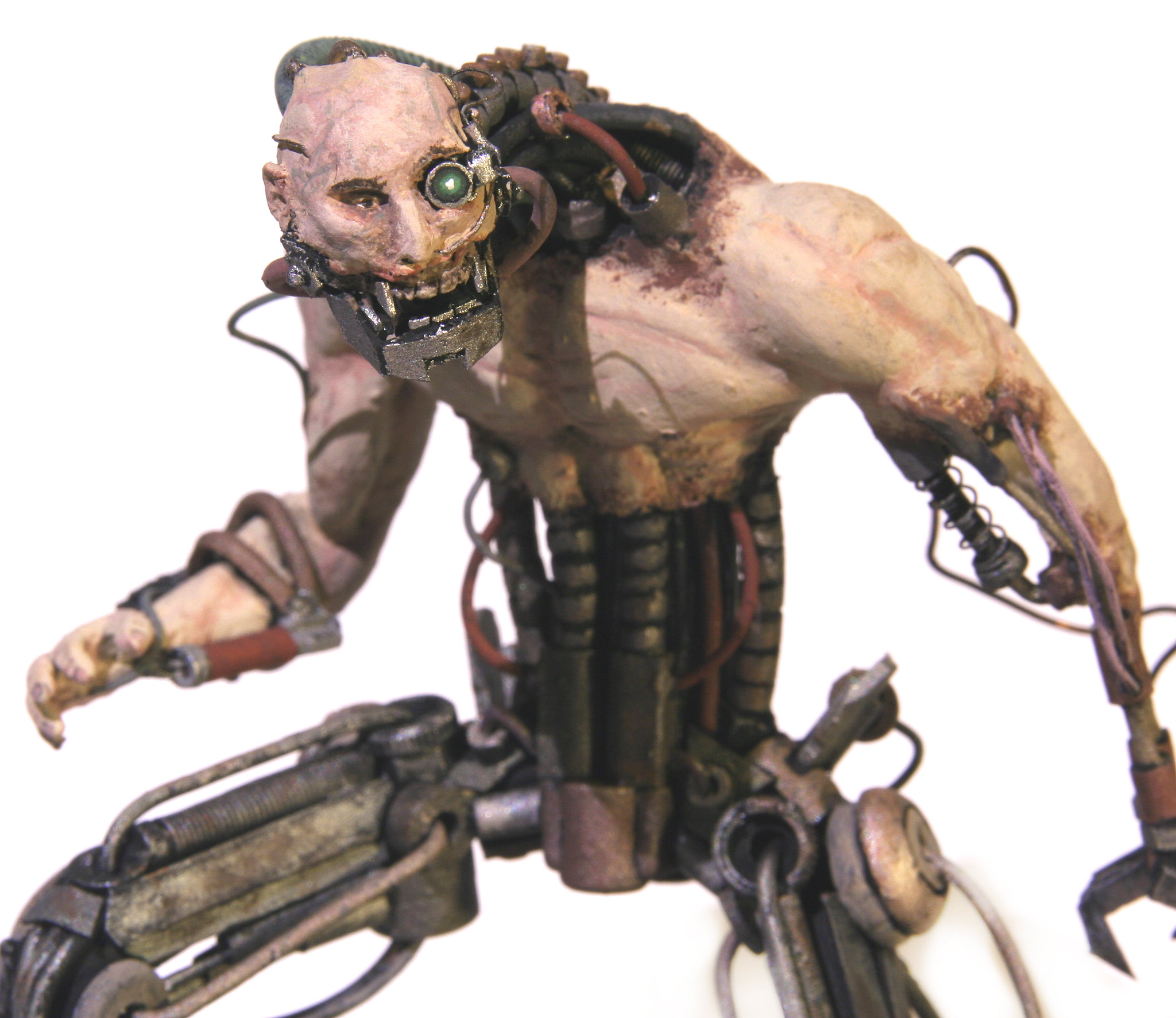
Deranged Machine Monk, Z'vatis Is My True Master, Metal > Meat

SlaveBeta is a Machine Monk who is under the control of a Melanis Z'bri named Z'vatis. Very little of his body is still flesh and blood - he owes his tortured existence to both Dr. Chalk's experiuments and Z'vatis' implants

Source: Flickr
Skills:
  • Fantastic(+6) Fight
  • Superb(+5) Physique
  • Great(+4) Shooting
  • Good(+3) Crafts
  • Fair(+2) Provoke
  • Average(+1) Will
Stunts:
Modular: Because SlaveBeta is more machine than human, he can quickly reconfigure himself for nearly any task. Once per session, he can swap the ranks of any two skills when making an Overcome roll or Create Advantage roll. The ranks remained swapped for the remainder of the session, but only for the purposes of Overcome or Create Advantage.

The Workshop (Location)

Source: TravelPod
Aspects: Atmosphere of Spiritual Despair, "Do You Hear Voices?", Poisoned Dreams

The Workshop is an area within the labyrinth of rooms and corridors inside The Institute. It contains a machine shop, a work area where the machine is being constructed. The Workshop manifests its own dedicated entrance to the physical orb through a series of tunnels in the Discarded Lands and, because of this, is also accessible from the River of Dream even when the Institute is not materialized. Even so, the interface between the Workshop and the outside world changes and corrupts the flow of the River. Z'vatis knows this, which is why he had SlaveBeta bring Hanna to the workshop.


Background

Hanna was a rising star and highly regarded as one of the most brilliant minds in Olympus. Over time, she began to take an interest in the River of Dream and Synthesis. Her studies turned toward less conventional areas such as the paranormal, ESP, psychedelics, etc. Hanna began sneaking into Tribal lands to secretly observe Synthesis use, as well as associate with Synthesis-using Fallen. The Elders in Olympus became concerned because of her trespasses into Tribal lands and warned her she needed to change the direction of her inquiries. Hanna continued her research anyway, often in secret. Her first real experiment in trying to harness the River of Dream through technology ended in tragedy. A second Keeper was reduced to a mindless husk and Hanna was badly injured. After a several week stay in the infirmary, Hanna was imprisoned to be tried for endangering the security of Olympus.

While awaiting her trial, she met another prisoner named SlaveBeta. SlaveBeta was a Machine Monk. Worse, SlaveBeta was under the influence of Z'vatis, A Melanis Z'bri working out of The Institute. Z'vatis became convinced Hanna's research held the key to opening the Fold, and through SlaveBeta arranged for the two of them to escape. Once free of Olympus, SlaveBeta led her to The Workshop where they began reconstructing her research and performing experiments.

Over time, a few other exiled Keepers joined the group, which Hanna named the Zetetics. Her obsession has continued to grow, fed by both Z'vatis' direct influence as well as the overall effect of being within The Institute. The other Keepers in the Zetetics are likewise becoming somewhat unhinged. Hanna's experiments have become more dangerous and grisly, and it's only a matter of time before her activities get noticed.

The Zetetics are growing from a very slow trickle of disaffected Keepers and even a few Fallen. Hanna was known around Talon Nexus and even Hom prior to her imprisonment, and occasionally people still seek her out for help. Some come to the group because they have nowhere else to go, others because they have heard about the experiments, and others because they have had visions or dreams leading them there. This latter group are often fodder for Hanna's experiments. The remainder guard The Workshop, gather needed supplies, or assist with the experiments. The machine shop is capable of producing reasonably complex parts, so the Zetetics tend to be rather well equipped - even for Olympian Keepers. If the Zetetics continues to attract new members, at some point they will be a bigger threat than the Machine Monks. Fortunately there are multiple groups who would try to stop her, provided it's not too late - specifically the Fatimas, other Keepers, the Guides and key Fallen such as Veruka the Wraith.

Software for RPGs

I've been looking around at various Windows applications or web services to help out with organizing or running rpgs. Once I sit back and look at all of the options available it's mind-boggling. We're in a virtual golden age (no pun intended). Here are some of the tools I've used or have found that help me out a ton when it comes to planning and running RPGs (this isn't including smartphone or tablet apps, because for gaming I use my laptop).

Organization
Google Drive should be a no brainer here - it gives access to everything a GM could need without having to invest in an office suite. It's been invaluable to me. The one drawback to using Google is they do have a track record of discontinuing services people actually use (or, at least, those people really like). I think, however, that Google Docs is likely going to stick around for a while. Dropbox is the obvious non-Google alternative (I use both, but nothing on Dropbox is shared publicly).

With just those tools, it's perfectly possible to organize and run a campaign. There are a couple more useful tools: Google Sites is somehow a wiki, but I haven't quite figured it out yet (it is a "simple wiki" and documentation is non-existent for it other than saying, "It's a wiki!"). Otherwise, I've found Wikia to be a reasonably good free wiki. There are also options like Obsidian Portal (which I haven't used yet although I did register).

One thing I really like are mindmaps. I've used both The Brain or Mindjet MindManager extensively, but I prefer Mindjet. The Brain does have an awesome feature that exports the map to a website structure. They are very good at creating relationship maps, and I actually once did a campaign map solely with a mind map. The one complaint I have with these types of software are kind of limited in how elements can be structured, and I wind up spending too much time fiddling with arranging things. The other drawback is they don't print well (as in at all), so you pretty much have to have a screen to display the map. There is an open source mindmap application called Freemind. I've played around with several mindmapping extensions in Google Drive, but they just don't work as well as a stand alone app.

Preparation
Two words: the Internet.

Aside from that, I've found just learning the basics with GIMP and Inkscape have worked wonders in preparing for games. I can edit images, create small graphics, do character sheets, maps, handouts, etc. I think any GM should at least know the basics of with these two applications (or something like them). For maps I'm not a huge fan of Campaign Cartographer, but I have used Dundjinni for both small and large scale maps and really liked it. It's too bad it is defunct from a development perspective.

The last one is the true treasure: YWriter. It's similar to Scrivener, but free. I have yet to fully delve into the program, but it allows for setting up characters, scenes, locations, items, and notes. All of these things can be cross-referenced and repositioned within the structure as needed. It also has a storyboard feature. The biggest drawback is it is a standalone Windows application with no Internet connectivity.

Play
I don't have much new for actual play, particularly because I don't use character generators or any kind of system software. I've toyed with creating an Access database for helping with various things, but I think my noggin, a rulebook and paper probably work just fine. One application that does look useful for play has been right under my nose, probably for years: StickyNotes in Windows (I understand that Mac OS has something similar). You can create any number of notes, change the colors, adjust the size, and as I recently found out you can even cut and paste spreadsheet cells or tables into them. I think that from a perspective as a Fate Core GM, I'll be able to use it and save a ton on Post-It Notes.

This probably doesn't scratch the surface of what's available to help with games. If there are any other awesome tools out there I'd love to hear about them. I'd definitely like to see web-based solutions geared specifically toward RPGs. Something like Obsidian Portal, but with a YWriter like scenario manager and possibly integration with Google Drive, Hangouts (or Roll20) and possibly Blogger.

Monday, May 6, 2013

Humorous (and Horrible) Gaming Experiences


I haven't had many truly crummy gaming experiences. Certainly not on the level of others I've read about. The same goes for funny experiences, at least beyond the silliness that ensues (I assume) in most game groups.

Among the bad experiences, but not the worst, were a couple of convention games many years ago. One was a Palladium Fantasy game that was, for all intents and purposes, a continuation of a regular game. Nearly all of the players were the regular players, and everybody else was handed the PC of a player that wasn't present. I received a female healer (I didn't have a choice) who was in a relationship with another PC (awkward). I was constantly having my actions countermanded by the GM as "That's not what she would do." I came up with an excuse to be somewhere else pretty quick.

The second game was a Champions game. Apparently the GM ran the same scenario, with the same characters, every time. The character sheets he handed out were stained, marked and falling apart. The scenario was like a railroad on a conveyor belt, bundled up and frozen to absolute zero. Predictably, after the game the GM asked for the character sheets back.

The last one was a GURPS game where the GM made everyone sign what amounted to an NDA promising not to reveal any of the contents of the scenario. He had some kind of prizes, but I never got around to figuring out what they were because the game was so mind-numbingly boring.

My worst experience, however, was playing Tribe 8. Prior to this game, my buddy and I had an awesome group that, unfortunately, split up due to a number of factors. We searched for a replacement group online and after talking to a few people thought we had found good matches. Showing up at their apartment, I finally knew the true meaning of "Cat Piss Man". The place was disgusting, reeked of cat piss and cat vomit and who knows what else. They let their cats rampantly jump up on people, knock things over, etc. There were some excuses given about illness (cat or human, I'm not sure), but we still cut the session pretty short. Granted, I'm the type that busts my ass to clean our house up even when people I know well who won't judge me are coming over. Near strangers? I have to fight back the urge to repaint the walls and scrub things that they'll never even see, like the underside of the refrigerator (yes, I said underside).

On the way home, my friend was pretty disgusted by the whole thing, plus being in the apartment caused a bad asthma attack (he had deadly asthma and a heart condition). I called the people and explained my friend had asthma and a bad heart, and their place wasn't fit for him to be in for long periods of time. The cats would need to be relocated or contained, and the place thoroughly cleaned. They seemed like all right people, so Anthony offered for us to play at his place (he did have the most awesome geek bachelor pad), but they had transportation issues. They promised it had just been a bad patch and that things were getting cleaned up. We went back for a second session, and it hadn't happened - on top of that, they were turning out not to be so all right, in terms of personality and appropriateness (which I was starting to get in email conversations). We made up a crisis, bailed and afterward I called the game off, citing our honest inability to function in that environment.

As for hilarious experiences, there were a couple good convention games. One was a Mekton Zeta game I was running, where the players totally got into their characters. A player rolled a "pet" on their Lifepath and decided it was a reptile-like creature named "Commander Mander", who he gave a little helmet proceeded to talk to the entire session. The second game was a Cybergeneration game that was supposed to involve the characters being trapped in a mall after dark, where we would have to fend off vampires or zombies or something. Instead, we never got around to that, instead running around the mall doing crazy things, getting into teen age drama, and then getting into a massive paintball fight that ended with one character getting accidentally shot with a real gun (one of the maxims of Cybergeneration was that the children of the Cyberpunk Edgerunners hated firearms). The GM just rolled with it, and it was awesome.

Right after high school I ran an unintentionally hilarious Mekton game set during a Kargan invasion of Elara. Two of the players, who were dating at the time, played the pilot and sensor operator of a recon mech. We established there was an access tunnel connecting the two cockpits, and the girl's character was in the top cockpit. Their in-character arguments in the middle of combat were true comedy, especially when she decided to drop wrenches on his head because he decided to go melee with another mecha (she had no piloting control over the suit). When he shut the hatches, she hacked them and dumped the whole tool bag on him. The game turned out to be a strange combination of Red Dawn, Stripes and M*A*S*H. To make things even more colorful, that game was typically hosted at my friend's house. His mom was remarkably...friendly. Nowadays she would probably be classified as a cougar. The bonus is she did make snacks and whatnot for game night.

Then there was the game - I think also Mekton, but perhaps Shadow World or Champions  - that broke out into a fist fight. Or, at least, a "throw a punch and the other guy runs away screaming" fight. All of the players had gone to high school together (or even junior high) except for me (I was introduced to the group by a mutual friend while I was in high school myself). Two of them had a running animosity, but one was extremely passive aggressive about it. After a few sarcastic remarks, the other one had enough, jumped up, and took a swing at him from across the table. What ensued was a bunch of running throughout the house with yelling, screaming, possibly crying, hiding, jumping over couches, and the host desperately trying to restore order before his grandparents were woken up.  Also, a wiener dog chasing everyone, barking and nipping at their ankles.

Similarly, a Cyberpunk game when I was in the Marines resulted in one of the players - a very short Filipino guy - throwing such a gigantic temper tantrum over something or other that we actually put him in a wall locker until he settled down.

I'm sure that there are a decent number of groups out there that have even more horrific or funnier stories. What are yours?

Thursday, May 2, 2013

Corollary to Things I Hate In RPGs

I realized there is a corollary (or set of them) to the things I hate in RPGs. This is mostly aimed toward game designers and publishers

1. Don't claim that your RPG is realistic, historically accurate or well-researched and then make stupid mistakes that prove it isn't. Especially don't make that claim and then write it takes five minutes and an armorer to clear a jammed assault rifle (Vampire: Undeath, I'm looking at you).
Also, deadEarth
2. Don't tell me how your game is only limited by my imagination. It's a role playing game. That's kind of what it already does.


3. Don't claim your game has a super innovative mechanic, only to have it turn out it's the same thing used in a dozen other roleplaying games. Especially if you're going to claim it's something like being able to choose to dodge, attack or parry. It just reminds me of this:


4. Don't tell me that your game is dark, or horrific, or gritty, or anything else without having something other than "Because I said so, look at the fonts!" to back it up.

"Do you have anything blacker?"
5. For the love of God don't tell me how your game "encourages roleplaying." See #2. It's already a fucking roleplaying game.


6. DO tell me if your game has limited options. Like if it's a science fiction game but missing the starship combat rules, or it's a game about playing three mice stuck in a mouse trap pondering the futility of their existence. I like to know these things up front.

Especially if one of those options is this

Things I Hate In RPGs (And Sometimes Gamers)

Here goes my break from blogging, because I found something I have to write about.

I've had a couple conversations recently that have been a bit frustrating in the relative pig-headedness of the other person. One of those was a bizarre PM conversation with someone on RPG.Net. It went kind of like this:
Them: "Fate can't do Blue Planet well. Fate is genre emulation and Blue Planet has no genre."
Me: "You can do it by doing this and this."
Them: "But that's cheating because you'd have to put a subsystem in place that wasn't there before."
Me: "..."
As a result, I'm putting this up as my (likely incomplete) list of Things I Hate in RPGs.

Nothing else needs to be said


Genre Emulation As A Goal: Genre emulation is a crock of shit. That might be a strong term - at the very least its use in the conversation above is. People use "genre emulation" to justify why their favorite game is better, or another game sucks. It falls under the same asshattery that demands paladins do certain things because they're Lawful Good or accuses games that dare to have meta game mechanics of  "not being roleplaying games".

Good games don't enforce genre. They enable it. Typically this is by including elements that help the feel of the game - it could be the writing, or the artwork, or the way that a particular rule or rules work. But they don't force the game to be played a certain way. Mekton Zeta - considered an "anime" genre game - has nothing in it that forces things to be "anime-like". Once you get rid of the hair color chart, and artwork, and strip down the construction system and remove any giveaway terms like "Beam Saber" or Transformation, it's just a good, fun game. That's because Mike Pondsmith is a good game designer and knows games aren't a straitjacket.

To address the paraphrased conversation above, by definition Fate Core has no genre. It has a built-in set of assumptions about game play - notably that the player characters are competent, or that fiction takes precedence over physics - but otherwise it provides a set of tools to help the table mold the rules to the game they want to play, and for everyone to provide narrative input. Does that mean Fate Core is a good fit for any kind of game? Of course not, but that's a taste and style preference more than anything. Just setting boundaries and defining aspects in a certain direction is going to help enable particular genre tropes. The game itself doesn't have super-specific genre rules. Spirit of the Century may have, but Fate Core is not Spirit of the Century.

Realism  As A Goal: This one is going to be a landmine topic. I don't give a damn if a game's rules are "realistic". Just like I don't want to play a genre simulator, I don't want to play a physics simulator either. For one, "realism" is another one of those things that gets trotted out as the reason why "Game X sucks", when truly what the critic means is "Game X isn't to my taste." But even when I'm playing a game that is supposed to be gritty, or low powered, or whatever term you want to use, there are a whole lot of things I don't care about. I don't care about the rules encapsulating things like, "An unladen European can jump exactly 1.875 meters." I do care about whether the results of applying the rules meet my expectations - how they get there is unimportant, at least in terms of the rule itself operating in a particular way. I'd use verisimilitude to describe what I look for in games, but that's kind of crap too. A few years ago I was using the term like it was going out of style. Now I realize it's a farce. If the rule or the results are reasonable, not boring, and I can reasonably say, "that could happen", then I'm good. It doesn't need to go any further than that.

Please, let's not go there
Immersion As A Goal: Wait, this one might be the one that blows up in my face. "Hate" might - again - be a strong word. Immersion should never be the goal of a roleplaying game any more than genre or reality emulation. That doesn't mean it's not important or doesn't exist. It's just that the game should enable immersion and not enforce it - provided it's even possible for a game to do either one in the first place. You can create a game whose goal is to enforce genre (which I think would kind of suck), you can create a game whose goal is to be "realistic" (which I know for me would suck). But you can't in reality create a game with the goal of enforcing or preventing immersion because immersion just happens. If there's a magic combination for making it work with genre or realism, there isn't one for immersion because it's entirely too personal.

Mostly I see people touting immersion over games. They say they things of the, "Game X sucks/isn't a roleplaying game because it yanks me out of immersion" sort. Personally, I think finding games that enable immersion is a snipe hunt that people get sent on to earn their "ROLE playing not ROLL playing" merit badge. Now I know someone is going to say, "Well Game X makes immersion impossible because of the meta game rules, but Game Y doesn't because the rules get out of the way." Do they actually? For that person I can buy it, but not the whole game for everybody..

Unfortunately, my experience with people complaining about immersion has been colored by a few bad eggs. They were the most likely to complain that their character would never do something, justify some fucktard thing their character did, or generally be inflexible and unwilling to cooperate with anything. The excuse was always something "breaks their immersion" or "I can't help it, that's the way my character is." The last person in one of my games that tried to murder the entire party because he was "in character" got bounced following that session (it wasn't the first offense).


Now if I don't like those things in my games or gamers, than what do I like? The first thing is balance - and not in terms of character balance. I'll play a game that is "realistic" as long as it is enjoyable. That doesn't mean, "I always get my way" or "I have to have a special snowflake character." I have plenty of love for realistic systems - but they have to written to be playable and allow for meaningful choices. While I place genre embellishments (and narrative control) higher on my list of likes than realism, again there needs to be a balance. My favorite genre games are the ones that have nods toward their chosen genre. They don't grab you by the throat and say, "There is only one way to play this game!" (and, as an aside, I avoid any game that says that regardless). Immersion is completely off the table when I decide if I like a game system, because I find immersion when and where I will. Most immersive roleplayers would disagree with me over what I find to be immersive anyway.

Wednesday, May 1, 2013

Going to take a break for a couple days

The A to Z April Blogging Challenge is over, and I need to take a break (I'm not getting paid for this, you know). So I'm going to restart next week on a regular schedule of Monday, Wednesday and Friday.

The challenge taught me a lot, mostly that it helps to have a focused theme when doing it. It helped that one of my personal truisms is that it doesn't matter what I write about as long as I write (and the corollary that it doesn't have to be good writing either)...so while I might have changed some of the things I wrote about it, I likely wouldn't have written them any better. If I do it next year, I'm going to plan a bit more (which sounds a lot like my take away from my first NaNoWriMo attempt was).

So, I'll see everybody next week!

Tuesday, April 30, 2013

Zero-Sum Games And When To Avoid Them

In game theory, zero sum games are when in order for one player to win, another player has to lose the same amount. Poker and many board games are an example of this, and it works well for them. Roleplaying games, by their nature, are not zero-sum games - but they can contain zero-sum conditions. Whether they are good or not depends. Zero-sum conditions can be intentional or unintentional, and either way can have a negative impact on the game.

When zero-sum conditions appear in combat systems, it's usually due to a choice nullifying another choice - which means there honestly wasn't a choice. For example, if in a game system the only effective defense is to parry, but you have to sacrifice your next action to do it, that's a zero-sum result. It happens with weapons and armor too, where armor and weapons consistently null out one another's offensive or defensive capability. It isn't bad - there's strong real life precedent for it - unless there's nothing else in the rules to help break the cycle. This may also happen in games that force accuracy to be sacrificed in the name of damage. More accurate weapons don't do enough to get through armor while heavier weapons aren't accurate enough to hit anything.


Sometimes the mechanics tip things in one character's favor too much, and if they don't provide a way to recover it becomes zero-sum. Death spirals (as much as I like Silhouette's damage rules) are an example of this. Once a character has taken damage they are more likely to take more damage, and it just continues to get worse. This means, in most cases, the character with the first significant success will win. It also doesn't help that characters in Silhouette with identical offensive and defensive skill levels have a high probability of not being able to hurt one another - making it two zero-sum games for the price of one (you can't hit the other guy most of the time, but if you actually do hurt him now you're more likely to keep doing it).

Any point buy-type system where the net result is no change are zero-sum. This is typically intentional - for example, there's no way to be ambidextrous without either spending points or taking a disadvantage. I don't find point buys like that to be a helpful way of maintaining character balance (a concept I'm dubious of as it is). I understand the reasoning, and that some people prefer it). I'd rather have distinct spheres of character ability (such as traditional attribute/skill splits, or skill/stunt/aspect in Fate) where points can't be traded between them. Balancing that out is a lot easier than trying to figure out if +1 DEX should be worth the same number of points as being agoraphobic.

That never gets old

Finally, we get to my last example of a zero-sum condition in an rpg: the players versus the GM. In games where the GM takes on an adversarial relationship with the players - especially more traditional games where there's nothing the players can do about it within the system - there's typically only one true outcome. The players "lose" (their characters are killed) and the GM "wins". This is nicely summed up on the TV Tropes entry for Killer Game Master. But it doesn't have to be the over-cliched extreme of the Killer GM. For some GMs,  it's "common sense" to do things like increase the difficulty of every encounter, skill check, die roll, etc. as the characters advance, in order to give players a "challenge". While it's great to tailor something to the power level of a group, doing so by rote can result in a zero-sum if everything included in the encounter completely nullifies every advantage the PCs have, then there's no real reason for the "challenge."

After all of this, it might seem logical to ask, "So what do I do about zero-sum games I don't want?" The answer isn't clear cut because it depends on the situation. Games like Fate Core address this by allowing invokes after the dice are rolled (meaning the use of the Fate points aren't a complete gamble), as well as in the concept of "failure as success at a cost". Other solutions might mean tweaking portions of the system to allow a loss for one player that doesn't automatically translate into an equivalent gain for another.

In the end, not all zero-sums are bad. Examining them is probably a good idea, though  - if only to make sure that the zero-sum condition is something that was intended (or even fun).

Monday, April 29, 2013

Vimary Redux


When Tribe 8 first came out, it wasn't a huge secret that the setting, Vimary, was the remains of Montreal, Canada (Vimary is a play on Ville Marie). But there wasn't a whole lot to go on, aside from looking up other maps and information on the area on the Internet. We didn't have Google Maps or Google Earth to get a bird's eye view of the locations in the game. Looking over street view and photos of different locations in Google Maps, I think there are some tweaks that can be made to Vimary as a whole.

First is the proximity of the Z'bri to Tribal lands. They're just too close for me to find it believable that half of the Tribes don't see them as a large threat, at least in the default starting point of the game. My solution, at least in my game, is to move the Z'bri lands on Vimary proper back across the river. The areas where they were become a no man's land, an extension of the Discarded Lands that acts as a buffer between the Z'bri and the Tribes. This can be seen as a mutually agreed upon DMZ. It facilitates all kinds of story opportunities for the Z'bri to harry the Tribes by releasing monstrosities into the no man's land and fostering Serfs, forcing the Joanites from the Seven Fingers to have to deal with them.

A corollary to this is the Seven Fingers gets an upgrade. In the canon setting, the wall is a very porous border. In my game, it gets beefed up into a formidable fortification. There aren't any holes to exploit (except going underground), and the Joanite population is increased. The line of the fortification actually crosses over and continues toward Duskfall, although the actual Seven Fingers are still located where they are now. In addition to the increased fortification, the Seven Fingers are also imbued with Synthesis to repel Z'bri (similar to how The Wall in A Song of Ice and Fire is warded against the White Walkers). In fact, I see the Seven Fingers as being a spiritual counterpart to The Wall.

Similarly, I think the Jo'han Skyrealms are too close for comfort. I can see a handful at most taking residence  high up in the remains of skyscrapers on the outskirts of Tribal land where they can't be reached from the ground. I think parts of the underground would be better suited for the Jo'han than living atop a skyscraper.

Speaking of the skyscrapers, these are structures I think the Tribals would generally avoid being near period so the Skyrealms might work out. Anyone who's seen Life After People knows that the elements, lack of maintenance and time conspire to bring these buildings down. They're just not that safe to be around. I do think the Tribals would make extensive use of the Emporiums year-round as opposed to in the winter season. The majority of the population in and around Bazaar probably live down there. It also gives them refuge in the event of some kind of attack.

There's a fort on the island. Why was that never mentioned?
As far as Hom, I've always envisioned that the amusement park that makes up the center of the settlement is in relatively decent shape. Part of this is due to once the Fall began, it just wasn't a place where people went to and suffered relatively little damage. The other part is due to the spiritual nature of the setting. Sure the place is still a shambles, but there are some structures that are not doing too bad. These are the structures like the ferris wheel, carousel, funhouse, etc. Maybe whimsical things like statues or whatnot are still mostly intact. Also, a lot of buildings on the island look really cool. I mean, there's a freaking fort there. As the Fallen come into their own, the place starts to look better and better. It gains less of a depressed, tent city atmosphere and more of a vibrant one. Part of this is going to be tied to the spiritual nature of the setting and things happening like when Lilith [REDACTED].

Access to Hom over the Fallen Bridge (the Pont de la Concorde) to me is not realistic. I think that the bridge would have near completely collapsed and would not be an easy access point onto the island. This is noted in Tribe 8 1e, but I think even "makeshift" efforts aren't enough to allow access. The South Tier (Jacques Cartier) bridge, on the other hand, would still be mostly intact. For some reason,  the rulebook doesn't make mention of the off ramps leading from the bridge to the island. While they might have partially collapsed, I can see access to the bridge being easier the other bridge. It would be the primary means for Fallen to get on and off the island (besides boats). Thematically it works well too - Tribals are perpetually looking down on the Fallen from the bridge, and Fallen going to the island have to descend to get there.

I've always assumed it's not important to get things 100% right - it is a fantasy game. The landscape will have changed through altered river courses, erosion, natural disasters, etc. Supernatural influences can shift things around and cause conditions that can't exist in the real world. But going back and looking over Google Maps and Google Earth...there's a lot of awesome stuff in Montreal and little tweaks that can make Vimary come alive.

Just catching up

This is a respost from my other blog, just highlighting the Tribe 8 that I've done in other game systems. At some point all of this will be added to the link section. As an FYI, all general roleplaying posting (even if it has to do with Tribe 8) is going to continue to be on Aggregate Cognizance, my other blog.

  • The newest is my completion of my Fate of Vimary draft, which consolidates the various rules modifications I've made to support Tribe 8 in Fate Core.
  • Next, I'm going to be doing a quick Spark setting write-up. This is actually for the eventuality that I run a dual Fate Core/Spark Tribe 8 game. I'm thinking two parallel games, but I'm not sure yet.
  • Previously, I had worked on an adaptation of Tribe 8 to Strands of Fate called Strands of Flesh and Spirit. Since reading Fate Core, I've stopped developing that branch but it's reasonably complete.
  • I also have a pretty much empty Wikia wiki called The Hundred Books. This will be an eventual rebuild of the wiki I once hosted on my website (which was sadly lost).

Your Game Has The Fate Fractal Too

Did you know your game already has the Fate fractal? Even if you don't know what the Fate fractal is? Well, it's true to one degree or another. Do you remember that time you wrote up a trap that attacks as a 10th level fighter? Or you assigned a hit point value of a door that had to be broken down? Or gave a penalty to driving rolls because of the car having a bad suspension? Or had the PCs roll saving throws versus cold in the middle of a storm? When you did those things, you were roughly operating within the Fate fractal.

For people who haven't heard of it before (or have and just aren't sure what it is), the Fate fractal is not so much a rule or a standardized process as it is a design pattern. The core parts that make up characters in Fate - Aspects, skills, stunts, stress tracks - aren't limited to just characters. Anything can have them if needed to show importance or enhance the narrative. The trap gets ranks in Shoot. The door gets a stress track. The car gets the aspect Bad Suspension. The storm gets the aspect Blizzard of the Century and a Frostbite skill to attack the characters.

So, if nearly every other game already has the equivalent of the Fate fractal, what makes the Fate fractal so different in Fate? The key word is equivalent. The Fate fractal isn't a hack or a stopgap measure. While most modern rpgs have unified resolution mechanics, most still have different systems for dealing with characters, inanimate objects, the environment, etc.. In Fate it's implicit in the system. It's possible for an aspect to have a stress track. Or an aspect to have an aspect. Or a stress track to have a skill. It abstracts out to a level that is not only still useful in game terms, but infinitely useful in making the game and the narrative work together.

The Fate fractal doesn't need to be used all the time - it usually suffices to name an Aspect and keep right on trucking. But when something is really  important, you can go further down the rabbit hole and do it without a whole lot of trying to fit round pegs in square holes. This is why I think, for the Fate fractal alone, every game master should at least look at Fate Core once it's released. The concept applies to nearly every game, and even if it's not used in the same way being cognizant of its existence is just another tool in the GM's toolbox.

Sunday, April 28, 2013

Xeno: A Fate Accelerated Edition One-Shot

After nearly a month of posting six-days a week it's not surprising that I'd miss a day. But real life does take precedence, and it's better late than never. I also think that this was well worth it, because I'm presenting a highly focused FAE hack: Xeno.

This is intended not only to show off various things that can be done with Fate Core. It's intended to happen with a specific structure - that typically found in the source material it emulates. It also may not be perfect, because I kind of rattled it off the top of my head in the space of a day or so. Either way, it should serve as a great starting point for anyone wanting to run a convention game, demo or other.

You can grab Xeno from this link:

Friday, April 26, 2013

Why Fate Core Is Awesome

+David Larkins  on the Fate Core G+ Community said he'd like to see a post on why Fate Core is awesome so here we are.

Why is any game awesome? Typically because it's fun to play, it has the options to support one or more styles of play, or it's rules are particularly well written, elegant, or hits the right spot in terms of what it covers. To me, Fate has all of those things. I haven't played Fate Core yet (working on that), but I have played Fate-based game and they were great.

It's fun to play because what the people around the table want out of the game inform the rules, and not the other way around. Aspects aren't just indicators of what the players want in the game - they're instructions for how to do it. When a character has the aspect My Favorite Dish Is Revenge, it's saying the player wants to have a game with betrayals and revenge and also communicates the theme and tone for that happens. It's a little capsule of how and why.

From a system perspective, for me it feels wide open. Rather than having to think outside the box to recreate some element in the game, Fate Core encourages redefining the box. It's not so much that Fate Core is the first to introduce concepts such as the treating anything like a character - in  other games a car, for example, might have hit points or stats like how fast or maneuverable it is. The difference is that in Fate Core if I want a haunted house, I just say it's a Creepy Old House. I don't have to figure out what kind modifier or rule covers "old" or "creepy".

But more than all that, Fate Core has a number of "Oh shit, I never looked at it that way before!" moments. I've always used some measure of "fiction over physics" in games I've run. I've also used some variation of "Yes and/but..." for years without realizing what I was doing.  But die rolls measuring the distance from success, and failure possibly being a success at a cost? That's huge. Conceding versus being taken out, and giving the player a choice in how badly they want to push in a conflict instead of just wearing down hit points until they're dead? That's exactly how I want characters being removed from play to work. The entire Fate fractal? Brilliant in its simplicity. It's like the first time that Basic D&D really clicked, after multiple times of reading it. Or the first time I heard Skinny Puppy and realized how much music there was in non-music. Or when I read Neuromancer for the first time. Or first picked up Tribe 8. Fate Core for me is a perspective-changing experience.

The feeling isn't just novelty either - it changes the way I look at every game. Even when I'm not running Fate Core, there's no putting the genie back in the bottle. Fate Core is part of my gaming consciousness now.

Thursday, April 25, 2013

Vimary Redux


When Tribe 8 first came out, it wasn't a huge secret that the setting, Vimary, was the remains of Montreal, Canada (Vimary is a play on Ville Marie). But there wasn't a whole lot to go on, aside from looking up other maps and information on the area on the Internet. We didn't have Google Maps or Google Earth to get a bird's eye view of the locations in the game. Looking over street view and photos of different locations in Google Maps, I think there are some tweaks that can be made to Vimary as a whole.

First is the proximity of the Z'bri to Tribal lands. They're just too close for me to find it believable that half of the Tribes don't see them as a large threat, at least in the default starting point of the game. My solution, at least in my game, is to move the Z'bri lands on Vimary proper back across the river. The areas where they were become a no man's land, an extension of the Discarded Lands that acts as a buffer between the Z'bri and the Tribes. This can be seen as a mutually agreed upon DMZ. It facilitates all kinds of story opportunities for the Z'bri to harry the Tribes by releasing monstrosities into the no man's land and fostering Serfs, forcing the Joanites from the Seven Fingers to have to deal with them.

A corollary to this is the Seven Fingers gets an upgrade. In the canon setting, the wall is a very porous border. In my game, it gets beefed up into a formidable fortification. There aren't any holes to exploit (except going underground), and the Joanite population is increased. The line of the fortification actually crosses over and continues toward Duskfall, although the actual Seven Fingers are still located where they are now. In addition to the increased fortification, the Seven Fingers are also imbued with Synthesis to repel Z'bri (similar to how The Wall in A Song of Ice and Fire is warded against the White Walkers). In fact, I see the Seven Fingers as being a spiritual counterpart to The Wall.

Similarly, I think the Jo'han Skyrealms are too close for comfort. I can see a handful at most taking residence  high up in the remains of skyscrapers on the outskirts of Tribal land where they can't be reached from the ground. I think parts of the underground would be better suited for the Jo'han than living atop a skyscraper.

Speaking of the skyscrapers, these are structures I think the Tribals would generally avoid being near period so the Skyrealms might work out. Anyone who's seen Life After People knows that the elements, lack of maintenance and time conspire to bring these buildings down. They're just not that safe to be around. I do think the Tribals would make extensive use of the Emporiums year-round as opposed to in the winter season. The majority of the population in and around Bazaar probably live down there. It also gives them refuge in the event of some kind of attack.

There's a fort on the island. Why was that never mentioned?
As far as Hom, I've always envisioned that the amusement park that makes up the center of the settlement is in relatively decent shape. Part of this is due to once the Fall began, it just wasn't a place where people went to and suffered relatively little damage. The other part is due to the spiritual nature of the setting. Sure the place is still a shambles, but there are some structures that are not doing too bad. These are the structures like the ferris wheel, carousel, funhouse, etc. Maybe whimsical things like statues or whatnot are still mostly intact. Also, a lot of buildings on the island look really cool. I mean, there's a freaking fort there. As the Fallen come into their own, the place starts to look better and better. It gains less of a depressed, tent city atmosphere and more of a vibrant one. Part of this is going to be tied to the spiritual nature of the setting and things happening like when Lilith [REDACTED].

Access to Hom over the Fallen Bridge (the Pont de la Concorde) to me is not realistic. I think that the bridge would have near completely collapsed and would not be an easy access point onto the island. This is noted in Tribe 8 1e, but I think even "makeshift" efforts aren't enough to allow access. The South Tier (Jacques Cartier) bridge, on the other hand, would still be mostly intact. For some reason,  the rulebook doesn't make mention of the off ramps leading from the bridge to the island. While they might have partially collapsed, I can see access to the bridge being easier the other bridge. It would be the primary means for Fallen to get on and off the island (besides boats). Thematically it works well too - Tribals are perpetually looking down on the Fallen from the bridge, and Fallen going to the island have to descend to get there.

I've always assumed it's not important to get things 100% right - it is a fantasy game. The landscape will have changed through altered river courses, erosion, natural disasters, etc. Supernatural influences can shift things around and cause conditions that can't exist in the real world. But going back and looking over Google Maps and Google Earth...there's a lot of awesome stuff in Montreal and little tweaks that can make Vimary come alive.

Wednesday, April 24, 2013

UML for Gaming?

Falling back on another programming-related post, because I didn't have anything else planned for today.

UML stands for Unified Modeling Language. It's a standardized set of notation and symbols for modeling workflows, data diagrams, etc. It's different than flowcharting because it covers details - though still high level - of how a process is supposed to work; the inputs, outputs and other interfaces; messages that are sent from one process to another.

Being a programmer, a geek in general, and a visual person means I really like diagrams and charts. I'm having a great time right now creating a chart showing the relationships between Spark rpg setting creation elements. A version of UML for gaming is really intriguing idea, but I'm not sure how practical it would be. From a system design perspective, it might be useful just to get the feel for how the system flows and identify any potential issues. There are a number of things in the UML standard that could be taken as is, but some of the notations and symbols would need to be changed I think, particularly several of the structural things and notations. Maybe someday I'll tinker around with doing a straight UML diagram of Fate Core combat or something just to see how it all fits together.


Tuesday, April 23, 2013

Tribe 8

I'm going to get lazy and make a Tribe 8 post for today's A-to-Z Blogging Challenge post, but it is actually rather timely so it's not that bad.

For those who don't know what I'm talking about when I mention Tribe 8, it is a roleplaying game published by Dream Pod 9 in the late 1990s. It is best described as a "spiritual post-apocalyptic dark fantasy" setting, with elements of body horror (the Z'bri), social upheaval (the Fallen), clockwork goddesses (the Fatimas) and a healthy dose of a New Agey vibe.  It is my favorite roleplaying game ever as it has a perfect mixture of horror, dark fantasy and post apocalyptic elements

Which one is the clockwork demi-diety?It isn't the bear
The line had about 25 books or so and a second edition, which isn't a sorry run by any measure. The second edition signaled the end of the line, although it had the grace to outline the remainder of the metaplot in very broad brushstrokes and detail a number of big reveals regarding the bigger picture.

That's right, I said metaplot. Coming on the coattails of the White Wolf pioneered splat book and metaplot business model, Tribe 8 had it in spades. The implementation was great in many respects and abysmal in others. A number of the metaplot books were well-written and were good at handling some of the sticky points with regard to players coming into contact with the plot. Others, not so much. In addition, many important pieces of information were dribbled out here and there, sometimes buried in in-character narrative (which, for better or worse, was a defining feature of the line). I've already opined about the lack of a Keepers sourcebook, which was the last thing the line needed to be complete. I've also posted about the metaplot in more detail.

So, the point of this post is to highlight some of the fan works I've created for Tribe 8.

  • The newest is my completion of my Fate of Vimary draft, which consolidates the various rules modifications I've made to support Tribe 8 in Fate Core.
  • Next, I'm going to be doing a quick Spark setting write-up. This is actually for the eventuality that I run a dual Fate Core/Spark Tribe 8 game. I'm thinking two parallel games, but I'm not sure yet.
  • Previously, I had worked on an adaptation of Tribe 8 to Strands of Fate called Strands of Flesh and Spirit. Since reading Fate Core, I've stopped developing that branch but it's reasonably complete.
  • I have a blog dedicated solely to Tribe 8 called Dreams of Flesh and Spirit. It is the spiritual descendant (no pun intended) of my long-gone Tribe 8 website of the same name.
  • I also have a pretty much empty Wikia wiki called The Hundred Books. This will be an eventual rebuild of the wiki I once hosted on my website (which was sadly lost).
If you think Tribe 8 sounds the least bit interesting, I highly suggest picking up the first edition core book and the Vimary sourcebook. They're really the only things you need to run a good Tribe 8 game. Get the core book in hardback, if you can find one. If you want even more, the Tribe 8 Companion (which can be hard to find), Horrors of the Z'bri, Into the Outlands, and Adrift on the River of Dream round out the additional "must haves". After that, if you want additional detail on the Tribes you can pick up the "Word" books - Word of the Dancers, Word of the Fates, Word of the Pillars. Finally, there are the Cycle books themselves if you want to run the metaplot. The set is rounded out by the non-metaplot books - Book of Legends, Harvest of Thorns, Word of the North and the Capal Book of Days.

Finally, Blood and Sacrifice is one of the best Tribe 8 fan sites out there, hosting material by some of the people who worked on latter Tribe 8 books. It includes the write-ups of the Destiny Deck cards, which are kind of like the Tribe 8 tarot (and, if it were up to me, an automatic stretch goal if a Tribe 8 Kickstarter ever happened).