Showing posts with label Flashback Friday. Show all posts

Friday, May 24, 2013

Flashback Friday: Mekton

In honor of the Mekton Zero Kickstarter, I'm doing something a bit different for a Flashback Friday. It's a flashback of some of my old material that I've recovered from the Internet Archive. This is the only Mekton design I was able to get (the archive is very spotty for my old website for some reason) but I'll also be reposting some other stuff like house rules and campaign outlines over the weekend. I've cleaned up the design a little bit and expanded on it. Hit the link below for the Google Docs sheet (sorry, no mecha design sheet...yet).

EMA-120 Lightning


The EMA-120 Lightning was first deployed in 1509, near the end of the Archipelago War. It was very successful in its role, but at the time was one of the most expensive Mektons fielded by the EDF. The Lightning project was born out of the Elaran High Command deciding it needed a unit capable of extremely fast, surgical strikes. The EDF, who in 1506 had introduced launching Mektons from submersible mecha carriers, also wanted a unit that could be launched and take flight while the carrier was submerged (previous units had to surface before becoming airborne). The solution was one of the first successful transformable Mektons for the EDF.

The Lightning was distinctive among 100-series Mekton designs, involving a large number of leading aerofighter engineers. The result was an aerofighter form that had a silhouette reminiscent of its namesake, with a slender pointed nose, a distinction humped fuselage, and engine nacelles set below. The cockpit was  further forward than most aerofighter designs, giving the impression of a shorter nose. The oversized powerplant and missile racks completely took over the torso/fuselage. Even though many of the lightweight materials used in later Mektons were not yet available, the Lightning's weight was kept down through a combination of intentionally lightweight design and a novel innovation:  the arms also served as the wings. A number of internal mechanisms, combined with a series of interlocking plates that extended from the torso and legs, turned the arms into the Mekton's trademark stubby, triangular wings. In humanoid mode, the cockpit was placed in the head. This made the pilot more vulnerable, and meant that the head-mounted weaponry typical of Elaran designs was left out. When the issue of the pilot's vulnerability was brought up, one of the aerofighter engineers was quoted as saying, "They're just going to have to try hard not to get hit." The design also conspicuously lacked anti-missile defenses. Against a Deathstalker's missile barrage, if the Lightning was hit it was guaranteed to be reduced to scrap - fortunately, it was ridiculously overpowered and far more maneuverable than nearly all of the Kargan units on the battlefield.

Service Record

Known as a hangar queen because of the complex transformation mechanism and unique powerplant, only 24 Lightnings were produced during the war. The Mekton was restricted to the 5th Fast Attack Wing, operating out of the submersible mechacarrier Koriel. It was only involved in a handful of engagements, all of them surgical strikes on high priority targets. The Mekton is particularly remembered for Karason Bay, where both Lightning squadrons, armed with anti-ship missiles on their wing hardpoints, carried out a surprise attack on the Kargan mechacarrier Garash and her carrier group. The Garash and all but two of the other vessels were destroyed, and the survivors heavily damaged. Only four Lightnings were lost in the pitched battle that resulted as the Kargans tried to rally a defense, and one of those was due to a malfunction. Lightnings also supported a mission to infiltrate the Kargan city of Tarkas by delivering Roadstriker-equipped special forces in custom wing-mounted pods. The Lightnings succeeded in inserting the Roadstrikers, but the mission ultimately failed. Overall, only six Lightnings were lost during the war, and one of those was due to a malfunction. After the Archipelago War the Lightnings were retired. Several were sent to various military museums, while 7 were assigned to the Stormriders demonstration squadron. By 1530 only a few remained operational because of their age, complexity and outmoded, nonstandard technology.

Variants

No variants of the Lightning were ever built. Pilot modifications were forbidden because of the Mekton's complexity and cost. Instead, the wing hardpoints were used for weapon pylons or to mount mission critical equipment. A typical fast strike loadout would include the Lightning's plasma rifle on one hardpoint and a heavy missile pod on the other. Long range missions would require the plasma rifle to be stowed and instead two fuel tanks mounted. As with many things about this Mekton, even the pylons or pods had to be specially manufactured to fit the design, as they needed to conform to the Lightning's unique transformation process.  The demonstration Lightnings assigned to the Stormriders are disarmed, with specialized smoke dispensers mounted in place of the missile racks in the torso.

Distinguished Pilots

Nearly half of the Lightning pilots were originally aerofighter pilots with no Mekton piloting experience. Lieutenant Drayck Athon was one of those pilots. While these transplanted pilots preferred to rely on their flight experience and resorted to humanoid mode only when necessary, Lt. Athon perfected combat maneuvers that incorporated the strongest advantages of both modes. Many of these involved multiple transformations between modes that one of the Lightning's engineers described as "Painful to watch." One of the most prominent was called the "A-drop". Lt. Athon would put his Lightning into a steep climb, often strafing his opponent as he passed, only to cut his thrusters and go into freefall far above them. At the last possible moment before passing his opponent he would transform to humanoid mode, deliver a close-quarters beam saber trike, and then switch to aerofighter mode again. Unfortunately, Lt. Athon was killed when he was tag teamed by two Deathstalkers. Missile barrages from both units destroyed the Lightning's legs, rendering it flightless. He succeeded in a controlled fall that collided with one of the Deathstalkers, and sent its hot powerplant into overload with a beam saber strike, destroying all three Mektons.

Friday, May 10, 2013

Flashback Friday: Cybergeneration


I was an enormous Cyberpunk fan in the late 80s and early 90s. I bought the original boxed set when it first came out and by the time the Cyberpunk 2020 line was finished I had every book, including ones published by third parties. The only game I have more memories of playing is Mekton.

So when Cybergeneration came out, it was an automatic buy for me. It wasn't an automatic love affair. Kids? Nanotech powers? Strange names for skills like "Lil Angel"?  Cheesy "yogangs"?. The Cybergeneration types were really awesome, the premise was cool, and I liked the stripped down system. A lot of the artwork was done by Alex Racine, an artist who was one of my favorites out of the R. Talsorian Games stable. I just didn't know what to do with it at first. I ran a couple of games and the system worked well, although the games fizzled out for various reasons. I did wind up buying the supplements because they had a lot of good information in them.

 Cybergeneration uses a simplified Interlock system. The base stats are the same but are capped at 8, as are skills. Like I mentioned, the skills list has been rewritten to better represent youth skills. Multiple "Edgerunner " skills are combined into one, such as Streetfighting covering pretty much all combat skills. Other examples include "Get a Clue" and "Blend". Overall the characters have fewer points than their CP2020 counterparts to represent the character's youth. The dice mechanics are the same as Interlock (1d10 + Stat + Skill), but the combat system is simplified and streamlined. In a clever move, the yogang skills have their level halved when going up against an adult.

It also had Akira hanging out with Ke$ha
The premise of the game is that in 2025, a nanotech virus called The Carbon Plague was unleashed. If it infects an adult, that adult dies. If it infects a kid, most likely nothing will happen but. In a small percentage of children, they are changed into one of the "Evolved". By 2027 the  government has rebooted itself with the backing of the most powerful megacorps and reasserted some semblance of order. For the most part, the streets are a lot safer than 7 years before, but it's at the expense of being completely beholden to the corporate machine.  The Edgerunners of CP2020 have retired, been killed or driven underground - the corporations won, in essence.

The Carbon Plague gives the kids an array of nanotech-driven abilities, divided into five types:
  • Tinmen: They are able to reshape their limbs T-1000 style.
  • Wizards: Basically Netrunners that can use their brains instead of a cyberdeck.
  • Alchemists: They can create objects and destroy them.
  • Scanners: They can manipulate nervous systems, both theirs and others'.
  • Bolters: They can use electrical ranged attacks.
Of course, the Incorporated States of America wants to get its hands on these kids. The book uses a guided introductory scenario to set up the PCs becoming infected, escaping the government forces that come and look for them, then going underground and finding the resistance. The setup works reasonably well, although I wasn't 100% fond of the way the mix of in-character and out-of-character information was presented (it was a bit too "busy" and fragmented). The old iconic CP2020 characters - Alt, Johnny Silverhand, Morgan Blackhand, Rache Bartmoss - are provided as leaders of the resistance and give a nice "lived in" touch to the setting. The presence of Arasaka just rounds out the reunion.

The game lends itself well to "MIB" or Matrix-type scenarios, with black-suited agents wearing sunglasses trying to chase down kids using "adult" tactics, only to be shown up and mocked when the kids use "kid tactics". In fact, the book drives the point home that the kids of this new generation don't solve problems the way their parents did. Violence is not best response, firearms are much harder to get, and other solutions are encouraged. In the chapter "Running Cybergeneration" there are even two sections in the book that talk about giving alternate solutions to problems: "Firepower Never Solves the Problem" and "It's Not All Guns, Guns, Guns." The chapter is rounded out with a "plotpath" chart, which was kind of a hybrid between the old Lifepath in CP2020 and the Beat chart in the Dreampark rpg.

While I bought the three RTG supplements (EcoFront, MediaFront and VirtualFront) I got out of the game before any of the Firestorm Ink books came out (I only had a vague notion that Cybergeneration 2nd edition or Generation Gap even existed). I might need to hunt those down.

Similar to Tribe 8, Cybergeneration tried to go in a slightly different direction using the same old systems that were grounded in design patterns of the late 1980s. There just wasn't any support for the kinds of things the characters were encouraged to do - non-violent solutions, social repercussions, acting on ideals and trying to build long-term goals. A game doesn't need to have explicit support for these things, but it really helps. So, hopefully no one will be too surprised if I say that I think a Fate Core conversion would be really great for Cybergeneration. I'm not sure when I'll do such a thing (I still have like five games to read), but it's a very real possibility.

Friday, April 5, 2013

Flashback Friday: Teenagers From Outer Space

Even with this A-to-Z Blogging Challenge thing, I'm still managing to crank out a Flashback Friday post (albeit a short one). This week is Teenagers From Outer Space (or TFOS).

TFOS was one of those odd duck games. I knew about Toon, but it never looked appealing. TFOS had anime stylings though, and anime was a new and trendy thing in the late 80s. At the time I was also reading Ninja High School and similar comics, and R. Talsorian Games was on my radar because of Mekton.


There were 3 editions, but I only have the first and second. The first edition was by far my favorite of the two. The system was extremely easy and freeform, comprised of a handful of attributes (including "Relationship With Parents") and then Knacks that were created by the players. We had an alien with the Knack I Accidentally Ate the Kid Who Was Doing My Homework For Me. Also, the writing was pretty funny, particularly the GM section. For the life of me, I can't remember the die mechanic except it used d6s (the 1st edition came with a baggie of miniature dice), but I think it was a simple roll over system. Instead of hit points or wounds, characters had Bonk and could not be permanently injured or killed.

Like most of R. Talsorian's Games it was apparent many of the characters and ideas came from the actual games that were played. I realize this happens with a great many roleplaying games, but in RTG's games it always had a familiar, kind of cozy quality to me that made me feel like Mike Pondsmith might magically pop up when we were playing a game.

Our games tended to rip off Ninja High School quite a bit, liberally mixed with movies like The Breakfast Club, Ferris Bueller's Day Off and even The Lost Boys. We also had a lot of Mekton involved. We had a Kargan exchange student heavily inspired by Worf from ST:TNG. Another character was a parody of the Miami Vice-inspired cop from the Roadstriker supplement. And, of course, lots of mecha. Our TFOS games actually contributed to several comedy routines that later showed up in Mekton games, such as failed missile attacks deviating toward the target most likely to produce comedic results (like a food cart, popcorn store, pillow factor, sewage plant, etc.).

These days, I could see TFOS as a brilliant system for an Invader Zim inspired game, or even something like Gravity Falls. It also is philosophically in the same space as Fate Accelerated Edition, which is pretty awesome for a game that's 25 years old. TFOS is available in PDF from DriveThruRPG.

Friday, March 29, 2013

Flashback Friday: Elfquest

Elfquest is something of an odd-duck for me.

What makes it so is there are a lot of mature topics and situations in Elfquest that utterly went over my head at the time. I didn't actually realize they were there until I went back and looked over some Elfquest stuff a few years ago after hearing about the possibility of a movie. To be fair, there were a lot of books and whatnot with mature themes I glossed over at that age. I had exhausted the children's section in the library by the time I was 10 and moved on to the science fiction in the adult section. I skipped over large parts in many books that were boring because I didn't quite understand or I was kind of weirded out.

I first read the Elfquest graphic novel at a Waldenbooks, probably in the 7th or 8th grade. A couple of years later I noticed the Elfquest boxed set at the local hobby shop and bought it. It was not my first encounter with Chaosium's Basic Role-playing system - the library had a smattering of roleplaying books and one of those was Runequest 1st edition, which I had checked out several times. That same Waldenbooks also had the boxed set for Runequest 2nd edition at some point, but I never bought it for some reason.

Anyway, Elfquest was pretty much standard BRP as far as resolution mechanics, stats, skills etc. The rules, examples and setting material were supported by generous use of panels from the Elfquest comics. The magic was customized for the setting, drawing from abilities seen in the Elfquest world - I don't remember all of them, but I do remember the Sending ability. On top of that, there were a lot of sample characters, including write-ups for almost every one of the original Elfquest characters. There were also descriptions of various other elf tribes (some of which didn't exist in the comics, and may never have existed), write-ups for various creatures, and some example scenarios. There was even a companion book with expanded rules and scenarios, and a sourcebook for Sea Elves. From what I understand, some of the material in the RPG was contradicted by later developments in the Elfquest comics, but I had long stopped following the series by that point.

My players hated this guy
The game was a radical departure from conventional D&D-style fantasy for me, and we played it for quite a while before moving on to other games. I staked out an area on the map of the World of Two Moons, created my version of The Holt and had the players roll up Wolfriders. Not having the standard fare of cities, towns, taverns, dungeons, etc. was challenging, but I remember we did all right. Most of the players had a good time with just roleplaying interactions between the characters, hunting for food, tricking humans and running from trolls. Having access to the Runequest hardback at the library I copied a lot of things out of it (usually by hand), and I want to say that the Broo made in an appearance in the game at some point. I have fond memories of tracing over and filling in the character outlines that came on the various character sheets. It was a good time, and while I'm sure the mechanics are probably a bit dated I'm sure for an Elfquest fan it would be a fantastic game.

Sunday, March 24, 2013

Flashback Fri...er, close enough: Space/Time

Last week got a little muddled, so I missed the Friday update. So here it is now.

This week's entry is a game from BTRC called SpaceTime. I played a fairly long campaign with it that started before I went into USMC boot camp in 1989 and picked back up after I was medically discharged for a knee injury later that same year.

He's going for his piece because the Fashion Police are coming for him.
SpaceTime used the TimeLords system and not BTRC's later system CORPS. I remember the game used a d20, and rolls were cross-indexed with a table that applied any modifiers on a sliding scale. For example, a -5 modifier compared to a roll of 10 would somehow scale to make it proportional. The setting reminded me of Voice of the Whirlwind. It had a cyberpunk aesthetic but highly advanced technology (but not quite transhumanist because that wasn't quite a thing yet). There was interstellar travel, an alien race, colonies on other planets, etc. I remember liking the cybernetics rules quite a bit. We wound up cribbing a lot of things from I.C.E.'s Cyberspace for the game, which was at a similar tech level to SpaceTime.

The large majority of the time spent playing SpaceTime was with a guy named John, who ran the game. John was the worst gamer stereotype - overweight, greasy black hair, loud, poor social skills, wore a trenchcoat. I think I was one of his only friends. At the time, I worked at Chuck E. Cheese as a technician and sometimes John would drop in before or after work. We would play right there in the restaurant because the place was mostly dead during the week. Unrelated to the gaming but related to Chuck E. Cheese, I worked with John Wick's younger brother there for a while, and Rick James came in once for a birthday party.

I just like the cake, bitch!
Anyway, my character was named Carissa and had been involuntarily modified to be a vampire. She had a thirst for blood, retractable fangs, aversion to sunlight, reflexes, you name it. Yes, it was incredibly cheesy, but I was all of 19 and had a huge thing for the goth chicks. I even had a picture of the character drawn by Gloria Yuh (an early VtM artist) when she was doing the character portrait rounds at the local conventions . I essentially shoved a photograph of my girlfriend at the time at her, gave Gloria some details for how the character should look, and she took it from there. I so wanted to include the drawing in this post because I was sure I still had it, but I couldn't find it.

We played through an extremely long story arc revolving around discovering how my character got the way she was, some technology the megacorporations were trying to perfect based on alien technology, the idea of real vampires  being aliens, and getting revenge on the people who had screwed up my character's life. We had a decent amount of fun with it, and it was one of the few times since I've started gaming that I was a long-term player instead of GM.

The game ended due to a variety of factors. I had moved out from my parents house where I had been staying after I got discharged. Shortly thereafter I turned 21 and started clubbing a lot more. I also started working at UPS. During that period, John started acting pretty strange. He showed up unannounced at my apartment on several occasions, creating awkward situations every time. Toward my female friends, some of whom were very attractive, he was often inappropriate. Things got exceptionally creepy after he tried to set up a lesbian encounter between my character and an NPC. I declined, saying I was extremely uncomfortable with the idea. He laughed and said it was weird in that awkward way people do when they don't believe what they're saying. Some time passed after that incident, then he told me that he couldn't continue to the GM for me because I wasn't "dedicated enough" and the game ended.

One thing SpaceTime did is put BTRC on my radar. I have CORPS and EABA, and I like the design philosophy behind both of them, although CORPS is a bit too crunchy for my tastes these days. Currently a Kickstarter for CORPS 3rd edition is running. It will be produced under license from BTRC.

Friday, March 15, 2013

Flashback Friday: The Apshai Trilogy

And now for something completely different.

Behold the wonder of 1970s video game cover art!
So far I've been posting about tabletop rpgs, but now I want to talk about a computer game because it actually contributed to my AD&D games. The game was later known collectively as the "Apshai Trilogy", but originally it was just one game and then two later expansions. They were made by Epyx, who put out a number of other pretty cool games in the 80s, including a star ranger/powered armor type game and a fantasy strategy game that riffed off the Battle of the Five Armies from The Hobbit. I played Apshai and those games on one of several Ataris and eventually a Commodore/Amiga/etc.

The gameplay was nothing revolutionary. You had a character with attributes and hit points and gold, and you moved around dungeons fighting monsters to get more gold and magic items and whatnot. It may have been ROGUE-like, but I never had any experience with ROGUE. I think the closest I've ever come to ROGUE was playing Telengard on one of our first IBM-clones.

Graphically, it was on par for its time - it looked a lot like ASCII art, but since the Atari was connected to something like a 13" TV (for a time, it might even have been a black and white TV) it didn't really matter. Epyx had a clever technique to make up for the lack of HD graphics - each game came with a little booklet that contained text descriptions of the various rooms. When you entered a room, there was a room number you could look up in the booklet. Add in the fact that you could precisely measure each room and map the dungeon, and we get to how this nifty little game contributed to my early tabletop rpg experience.

Behold the wonder of 1980s graphics!


Armed with graph paper (I bought it so regularly the people at the stationery store down the street knew to set aside a few pads of it if they saw me coming) I mapped every ten foot square of the dungeons in each of those three games. I then was able to take my Monster Manual and find matches for every monster encountered in the game. Then it was just a matter of using the maps with game booklets and I had some pretty well laid out dungeons with very little effort. At some point, I even managed to type all of the room descriptions in to a word processor so I could remix them into completely new dungeons.

The beautiful thing about it was that they were dungeons (or Dunjons) that nobody had played through before. Because of limited funds, at that time we had recycled modules two or three times. For populat modules, it was hard to find people who hadn't played through them. Everyone was excited when I unveiled a brand new homebrew dungeon. When the Monster Manual II came out, the Thri-Kreen became the race I used for the ant-men and it turned into a whole campaign centered around Apshai, the Thri-Kreen and maps of temples I copied from the appendix in a KJV Bible (much to my mother's disapproval).

It's probably worth noting that the Apshai Trilogy was my first ever foray into but screwing around with code. The games were written in BASIC, and there weren't any such things as compilers or encryption back then. Think about it like editing config files for a PC game. I could give myself virtually unlimited hit points, or gold, reveal all of the secret doors, make myself whatever level, or make my weapon do some insane amount of damage. The novelty wore off pretty quick but it was helpful in mapping out the dungeons.

Now what I want to do is grab the room descriptions, track down some maps of the dungeons, and hack together a Fate Accelerated Edition game mimicking a Basic D&D sandbox type of dungeoncrawl. Use approaches for the character classes, stunts for racial abilities, magic and class abilities, and go to town on giant rats, spiders, scorpions, the occasional jackal, mummies and (of course) ant-men. I'd probably read the fluff straight from the book, too.

Friday, March 8, 2013

Flashback Friday: Algol

Mekton from R. Talsorian Games has always had a default setting called Algol. The setting is essentially a showcase for all kinds of 70s and 80s anime concepts. It's an Earthlike world but with oddities ala Super Dimensional Century Orguss or Super Dimensional Century Southern Cross. There  is Gundam-like mecha, psionics, reptilian alien bad guys, lost technology, wandering mecha nomads, technopriests and of course big, brightly-color anime hair. The game has gone through several editions, but Algol has remained as the stock setting for every one of them.


Algol was settled by refugees from an intergalactic war against an alien race called the Aggendi. The Aggendi  wiped out the colony and left, thinking the job was done. The survivors, blasted back practically to the Stone Age, eventually rebuilt and spread across the planet. As the centuries passed, two large nations evolved, one on the northern continent and one on the southern - the Elarans and the Kargans. The archipelago of islands across the equator held a number of smaller nations, mecha nomads called the Etarrans, and the sub-continent of Muria. The egalitarian Elarans were descended from the relatively peaceful descendants of the original civilian scientists, doctors, teachers, etc. The totalitarian Kargans were descended from the colony ship's crew and military contingent.

Algol

Eventually, two things were discovered: the secrets of technology locked away in the remains of the original colony ship and that Algol was undergoing an ice age. The two nations began to jockey for land in the warmer archipelago, and a series of wars broke out between them - either directly or through proxies in the Archipelago. Once the secrets of the Mektons that were once used to defend the colony were unlocked, it was totally on between the two nations.

There's a whole lot of awesome in the setting. The inhabitants live in arcologies, connected to one another by fortified elevated roadways, for protection from weather extremes, the local wildlife, and enemy attacks. The Murians fill the role of mysterious technopriests - almost like Atlanteans - with their high technology, psionics and all encompassing force field that keeps everyone out. The appendix in the original Mekton book included all kinds of neat descriptions of various arcologies, personalities, and creatures.

It shouldn't need to be said that the biggest piece of awesome in Algol are the mecha. The Mekton Techbook expanded on the original build system for Mekton II and made it in a fantastic, flexible system and at the same provided a Jane's Fighting Mecha of Algolian Mektons. In a clever move, the listed mecha start with basic models (the biplanes of Mektons) and move forward in time as technology improves. Even better, the descriptions of each Mekton provide vignettes into Algol's history by mentioning battles, personalities and other events. The drawings of the mecha were done by Jason and John Waltrip, who have also done art for Car Wars and Robotech: the Sentinels and other comics.

It takes a lot of intakes to get a Deathstalker in the air

The setting even got the anime-series treatment in the form of the Operation Rimfire campaign. I still regard Operation Rimfire as one of the best campaigns I have ever run. Basically, you played the crew of a spaceship constructed solely for traveling to Algol's outer system to investigate an anomaly. The book itself was gorgeous, with great art and full color glossy pages giving character backgrounds, maps, etc. Unfortunately it was soft-bound, so the pages eventually started to fall out. As can be expected from a pre-published adventure there are rail-roady parts and pacing issues, but it had a good mix of character development and action, a few twists, and a suitably dramatic big-boss ending.

Mekton Zeta, the last edition of Mekton, expanded upon the setting by using the end of Operation Rimfire as a launching point. It described the rest of Algol's star system and the new bad guys - the returning Aggendi, which it retconned from saurians into a kind of insectoid species. The technology base for the mecha was also advancted. Unfortunately, a lot of the accumulated material from previous editions was either paraphrased or left out, so the Algol presented in Mekton Zeta seemed a little bland. The example mecha designs for the Algolians weren't quite as interesting, either.

I have extolled Mike Pondsmith's virtues before, and the Algol setting is further proof he's a master game designer and story teller. Pondsmith manages to meld many disparate influences together seamlessly and organically, polishing them into a really fun setting with a lot of gaming potential.

Friday, March 1, 2013

Flashback Friday: Starblade Battalion

Starblade Battalion is sort of an alternate Cyberpunk 2020 future, as a setting for Mekton Zeta. It had cybernetics, megacorporations, starships, mecha, pirates and planets with dinosaurs (kind of). The setting is about nearly two centuries after the events in CP2020. The Earth is environmentally ravaged and is ruled by a world government. The solar system has been colonized, and faster than light travel has allowed mankind to go to the stars. Of course, the evil corporations want to plunder and ravage the off world colonies while the government back home has become dominated by ecological zealots, and the colonists aren't getting a say in the matter either way. Needless to say, the situation isn't destined to end well.
Enter the Starblade Battalion, the Default PC Group. It's a rogue paramilitary organization made up of defectors from both sides plus the usual collection of misfits. Pirates, too. Without the pirates, we wouldn't have an excuse for the awesome crossbones-inspired mecha design. They've accumulated stolen and otherwise misappropriated ships, mecha, military hardware and even managed to abscond with the setting's equivalent of The Skunkworks so they can develop their own toys. Their mission is kind of humanitarian: protect innocent people from getting squashed in the fighting, and try get both sides to see how pig-headed they're being especially when millions of lives are at stake. 
Draken
The setting's mecha designs were somewhat reminiscent of SPT Layzner  There was also a terrifically cool concept called a cutter, where the mecha docks to the front of a small starship. It's reminiscent of the Legioss/Tread combination from Mospeada except the cutter is a ship capable of supporting a small crew, as opposed to another type of fighter. Cutters mount FTL drives and give the PCs a good class of ship for flitting around the universe in.
If one element in the setting didn't quite jive for me, it was the descriptions of the planets the off world colonies were on. I suppose for an anime-inspired game it's actually not that awful, but the planets seemed cartoony to me when I first read them. They included the old tropes of a desert planet, jungle planet, etc. One of them even had dinosaur analogs, if I remember right. Again, this isn't actually something that was a serious problem with the setting. Starblade Battalion wasn't meant to be hard science fiction, and Mass Effect's cardboard cutout planets don't ruin the series for me.
Overall, it was a nifty little setting for those that wanted a post-CP2020 feel for their games with mecha. These days it probably doesn't stand out quite so well in light of all the other games where Earth has suffered an ecological collapse and now the colonies are trying to get independence and everyone's worried about greedy corporations ruining outer space (Jovian Chronicles, Blue Planet) but Starblade Battlion still has a few hooks of its own to distinguish it. Mostly the mecha. Especially the mecha.
Finally, in case you're interested there was an extremely long-running Starblade Battalion fan fiction and a pretty extensive website that is surprisingly still up. I won't make any commentary as to the quality of the fan fiction. The website also had some concept sketches from the guy who drew the mecha (you can catch them from the Internet Archive). Starblade Battalion is also available in PDF from DriveThruRPG.

Friday, February 22, 2013

Flashback Friday: Living Steel

I'm going to start a feature of sorts revisiting a few older and possibly even a little obscure settings or game systems. Not reviews but more of personal recountings of what I genuinely liked about the games without concentrating on the negatives.

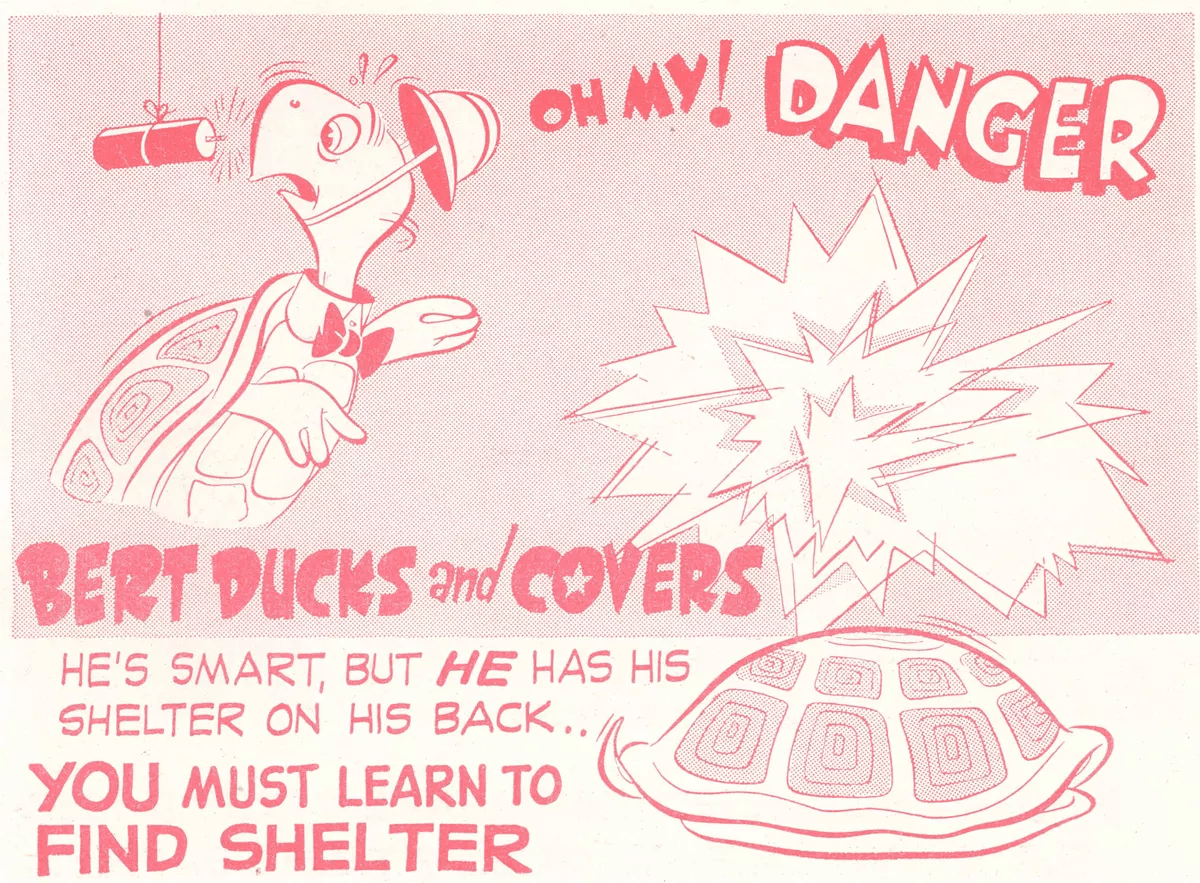
I have a soft spot for post-apocalyptic games, movies and books. I think this goes back to living for the first half of my life under threat of nuclear war (probabilistic or not). I entered elementary school at the tail end of when they were retiring the old civil defense movies. By that time, they'd abandoned the "Duck and cover"-type videos of the 1950s and moved on to, "When you hear a siren, just find someplace to sit down and wet yourself." Watching The Day After and Threads didn't help matters much. There's nothing like realizing, "I live in California. We don't have cellars or basements." Living close to a number of key military bases may not instill the same nervousness as having a Minuteman silo in the backyard, but it doesn't help either.

It worked out well for those people in Threads.

So I gravitated towards games like Ogre/G.E.V./Battlesuit, The Morrow Project, Gamma World, After the Bomb for TMNT and Twilight 2000. I also love war machines and mecha. Combine the post-apocalypse with powered armor and I'm set.

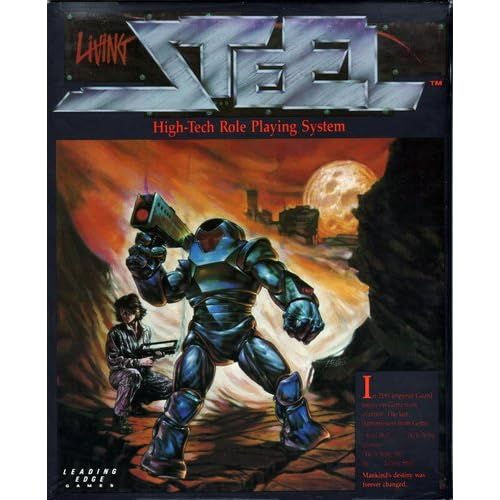
Which leads me to this week's flashback: Living Steel. I first discovered it at a convention, where the folks from Leading Edge Games were running a demo. The guys running it made it look downright easy. Little did I know they were actual rocket scientists. I bought the entire line, using my game purchasing budget (and probably part of my food budget too), and spent the next few weeks trying to figure out the mechanics. We tried to play it once and only once, and then gave up for a Mekton game. I don't remember a whole lot about the game system except it was extremely complicated. Regardless, I want to go over the cool bits in the setting and not the system.

One thing I remember about the demo is we were part of some scouting party and located a village or town. Having a heavily armed and armored group roll up to their settlement made the locals understandably nervous; since my character was the leader I was volunteered to talk to them. One of the features of the powered armor is the ability to project an image of the wearer's face, apparently to make the armor more personable. I successfully reprogrammed mine to display a whopping yellow happy face. The discussion went south when one of the locals decided to attack me. I wound up picking him up and trying to explain we were there to help, all the while with that giant happy face on my visor.


Is it me, or does he look like he might have a little problem with gas?

If memory serves me right, in Living Steel there was an interstellar society which was defeated by a one-two punch. The Seven Worlds were defeated by an evil empire, but had placed a number of genetically modified supersoldiers in stasis to be awakened when the timing was right. One of the planets they were placed was Rhand, which was (if I remember correctly) a resort or vacation planet of some kind. When Rhand is attacked by a race called the Spectrals, the soldiers (i.e., the PCs) are awakened.

The Spectrals themselves were fairly interesting. They had a warrior type, which was bipedal and kind of Alien-looking. It was exceptionally strong, could see through walls, and was able to incorporate weapons and technology into itself. There was also a spider-looking "brain" type that had psychic powers. They have a hive mind and had some other servitor races they brought along for the ride.

The Spectrals attacked by taking out orbital assets (such as communications) and then spreading a virus planet side called VISR. VISR stood for "Virally Induced Sociopathic Response". Once the population had been reduced to a bunch of Mad Max-style ax murderers and society utterly broke down, they finished their invasion. It would have worked too if it weren't for those meddling Seven Worlders and their powered armor. The invasion not only devastated civilization on Rhand but triggered whatever condition necessary for the release of the super soldiers. They were woken up from their stasis, paired up with some civilian scientists, engineers, etc. who were also in stasis, and set about trying to fight off the Spectrals and reestablish their civilization.


One of the other features of the setting was a teleporter satellite network, called ORCA. The satellite allowed instant transportation from one point on the planet to the other. All but one ORCA satellite was destroyed, and the remaining one damaged. This translated to the satellite only being able to teleport teams once a day or so, and if I remember right the teleportation could be somewhat erratic and imprecise. It was still a reasonably good advantage to have over the opposition.

I also loved the cheesy quotes sprinkled throughout the books' margins. I still remember some choice ones:

Blam. Blam. "Stop." Blam. Blam. "Police."

"We would have believed it was an accidental shooting if he hadn't changed magazines...twice."

Overall, it was kind of a neat setting saddled with a terribly clunky system. I'd actually like to revisit it at some point, because I'm certain it would make a great game using Mekton, Silhouette or even a FATE-based game.